AI and IoT Solutions Built for Industrial Construction Jobsites

Identification and location software for crews, contractors, equipment, tools, vehicles, and materials across complex industrial construction projects.Industrial construction projects are among the most demanding operational environments in the construction industry.

AI and IoT Site Tracking for Industrial Construction Projects Using RFID, BLE, GPS, and Access Control

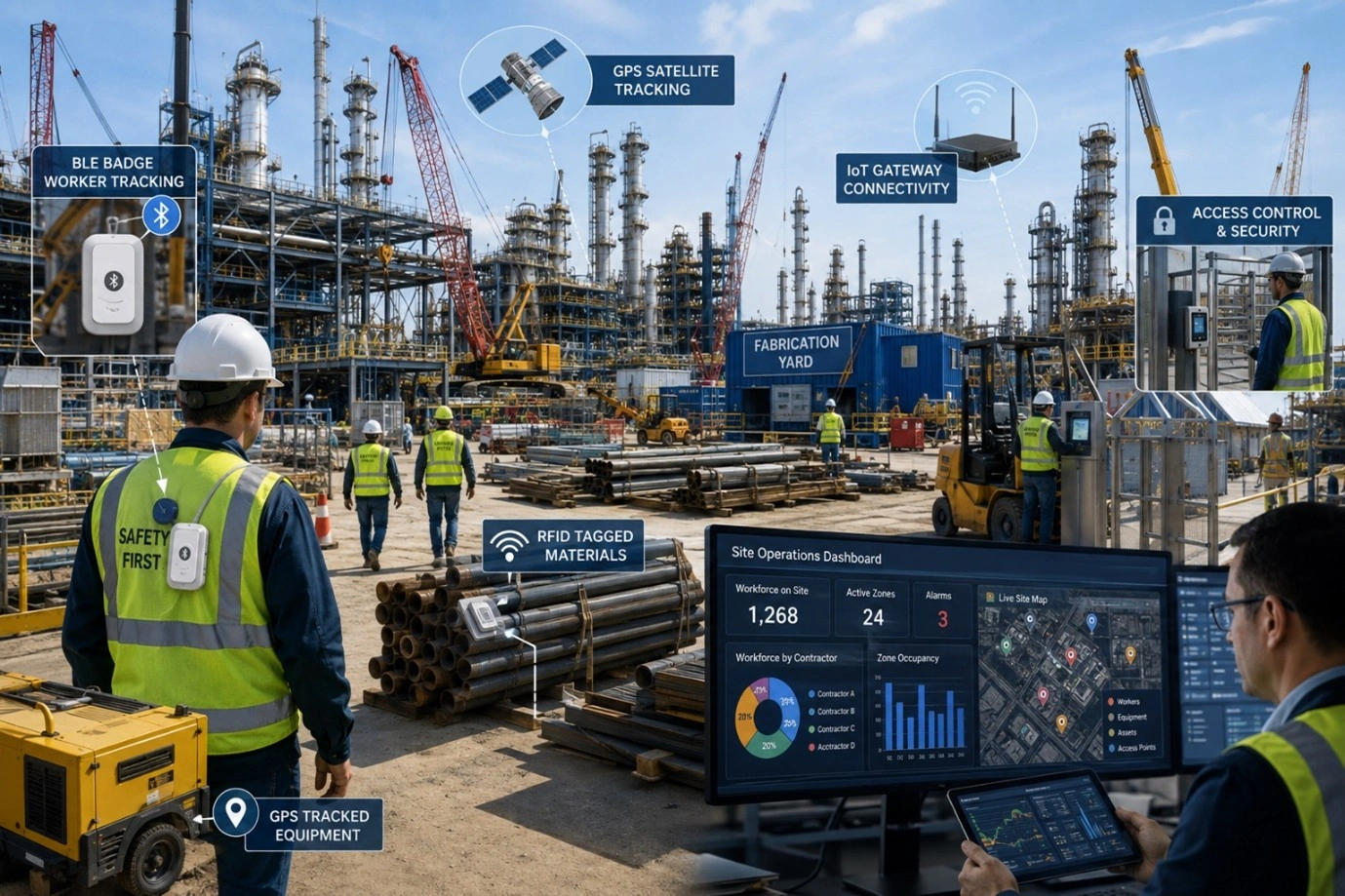
This visual shows an AI and IoT-enabled industrial construction project featuring workforce tracking, access control, asset tracking, and material visibility across a large refinery construction site. RFID-tagged materials, BLE-enabled worker identification, GPS-tracked equipment, and centralized operational dashboards provide real-time visibility into jobsite activities. The image demonstrates how AIoT technologies improve workforce accountability, equipment utilization, inventory management, and project coordination in complex industrial construction environments.

Industrial construction site with refinery structures, tracked workers, RFID materials, GPS equipment, and access control systems.

AI and IoT for Industrial Construction Site Visibility

Industrial construction projects differ significantly from commercial and residential construction projects. These projects often involve:

01

Multiple contractors and subcontractors

02

Large project footprints

03

Strict safety requirements

04

High-value equipment and materials

05

Complex logistics operations

06

Fabrication and assembly activities

07

Temporary and evolving work zones

08

Regulatory compliance obligations

Visibility across these environments is critical to project success.

AI and IoT technologies help create a connected jobsite where personnel, equipment, materials, and operational activities can be identified, located, analyzed, and managed more effectively.

Identification and location technologies support:

01

Worker accountability

02

Contractor management

03

Access control

04

Equipment tracking

05

Tool tracking

06

Inventory management

07

Material traceability

08

Project progress visibility

09

Security management

10

Compliance documentation

AI systems then analyze this information to identify patterns, detect anomalies, improve resource allocation, and support operational decision-making.

Core Capabilities for Industrial Construction Projects

01

Workforce Safety and Personnel Visibility

Industrial construction projects frequently involve large workforces operating across multiple work fronts.

Workers may be assigned to:

01

Structural steel erection

02

Mechanical installation

03

Electrical construction

04

Instrumentation installation

05

Pipefitting activities

06

Welding operations

07

Commissioning preparation

08

Fabrication operations

AI-enabled workforce tracking provides visibility into worker locations and movement patterns across the site.

Key capabilities include:

01

Worker location analytics

02

Real-time headcount visibility

03

Muster management

04

Crew deployment analysis

05

Hazard zone awareness

06

Workforce accountability

07

Emergency response support

08

Contractor workforce management

These capabilities help project teams improve safety performance while supporting more effective workforce coordination.

02

Access Governance and Jobsite Security

Industrial construction projects often contain restricted areas where access must be carefully controlled.

Examples include:

01

Energized electrical areas

02

Process equipment zones

03

Confined spaces

04

Commissioning areas

05

Hazardous work locations

06

Temporary exclusion zones

AI-enabled access management solutions support:

01

Credential verification

02

Visitor management

03

Contractor authorization

04

Restricted area monitoring

05

Access event analysis

06

Compliance reporting

07

Audit trail generation

08

Security investigations

Automated access governance helps improve accountability while reducing administrative effort.

03

Equipment Utilization and Asset Accountability

Industrial construction operations depend on extensive fleets of equipment and mobile assets.

Typical tracked assets include:

01

Cranes

02

Forklifts

03

Manlifts

04

Generators

05

Welding equipment

06

Compressors

07

Mobile tools

08

Temporary power equipment

09

Fabrication equipment

AI-powered asset tracking helps organizations:

01

Locate equipment quickly

02

Reduce equipment search time

03

Improve utilization rates

04

Prevent loss and theft

05

Support maintenance planning

06

Optimize deployment decisions

07

Improve operational efficiency

Location-based analytics provide valuable insights into how equipment is used across the project.

04

Material Optimization and Inventory Management

Material availability is one of the most important factors affecting project schedules.

Industrial construction projects manage large quantities of:

01

Structural steel

02

Pipe spools

03

Valves

04

Electrical equipment

05

Cable reels

06

Instrument assemblies

07

Mechanical equipment

08

Fabricated modules

AI and IoT inventory solutions support:

01

Material identification

02

Inventory visibility

03

Stock reconciliation

04

Receiving verification

05

Material allocation tracking

06

Laydown yard management

07

Reorder planning

08

Waste reduction initiatives

Technologies Supporting Industrial Construction Site Tracking

Industrial construction projects require multiple identification and location technologies to support different operational requirements.

01

RFID Identification

RFID technology enables automatic identification of:

WorkersEquipmentToolsMaterialsComponentsInventory items

RFID is commonly used for material receiving, inventory management, asset identification, and access verification.

02

BLE Location Tracking

Bluetooth Low Energy technology supports:

Worker location visibilityCrew proximity analysisZone occupancy trackingWorkforce accountabilityAccess area validation

BLE is particularly useful for indoor and partially enclosed construction environments.

03

GPS Location Services

GPS technology supports visibility for:

Fleet operationsMobile equipmentVehicle trackingEquipment logisticsGeofencing applications

GPS provides location awareness across large industrial project sites.

04

Cellular Connectivity

Cellular communication supports:

Mobile asset trackingRemote project visibilityDistributed construction operationsFleet management

Cellular networks help connect assets operating across broad geographic areas.

05

LoRaWAN Communications

LoRaWAN technology provides cost-effective communications across large construction projects where long-range coverage is required.

Applications include:

Material yard visibilityAsset location supportWorkforce coverageLarge project site communications

Deployment Options

Industrial construction organizations have varying operational and security requirements.

01

Cloud Deployment

Cloud-based solutions provide:

  • Multi-project visibility
  • Centralized reporting
  • Remote project management
  • Contractor collaboration
  • Flexible scalability

Organizations managing multiple project sites often benefit from cloud deployment models.

02

Server Deployment

Server-based solutions provide:

  • Localized control
  • Internal network management
  • Site-specific security requirements
  • Customized deployment configurations

Server deployment options support projects with specialized operational requirements.

Applications Across Industrial Construction Environments

01

Industrial Plant Construction

Large industrial facilities require extensive coordination of personnel, materials, equipment, and contractors.

AI and IoT tracking solutions improve visibility throughout the project lifecycle.

02

Refinery and Petrochemical Projects

Refinery construction projects often involve strict access requirements, contractor management challenges, and extensive material accountability needs.

Identification and location solutions help improve project control and compliance.

03

Power Plant Construction Sites

Power generation projects require coordination across civil, structural, mechanical, electrical, and commissioning activities.

Workforce visibility and asset tracking support project execution and schedule management.

04

Manufacturing Facility Build-Outs

Manufacturing projects require precise coordination of equipment installation, material logistics, and contractor activities.

AI-powered site tracking improves operational visibility across these environments.

05

Heavy Industrial Fabrication Yards

Fabrication yards depend on effective management of materials, components, tools, equipment, and work activities.

Location-based visibility helps improve efficiency and accountability.

AI-Enabled Industrial Construction Site Tracking Workflow Using RFID, BLE, GPS, and Workforce Visibility Systems

This workflow diagram represents how AI and IoT technologies support workforce tracking, access verification, equipment visibility, material tracking, inventory management, and project reporting across industrial construction environments. Data from RFID, BLE, GPS, Cellular, Wi-Fi, and LoRaWAN technologies flows through edge and cloud processing systems into AI analytics engines that generate operational reports, compliance records, alerts, and management decision support. The visual demonstrates how AIoT solutions improve workforce accountability, access governance, equipment utilization, inventory accuracy, material traceability, and project execution across refinery construction, power plant construction, fabrication yards, and other industrial construction projects.

Why AIoT Identification and Location Solutions Fit Industrial Construction

Industrial construction projects are dynamic environments where workforce deployment, equipment allocation, material availability, and contractor coordination change continuously.

Identification and location technologies provide operational visibility that supports:

01

Improved worker safety

02

Better contractor management

03

Enhanced equipment utilization

04

Stronger inventory control

05

Reduced material losses

06

Improved schedule management

07

Increased project accountability

08

Better compliance documentation

Project teams gain the ability to make decisions using objective operational information rather than relying solely on manual reporting.

REAL-WORLD INDUSTRIAL EXPERIENCE

Experience Built on Real-World Industrial Deployments

IndCon AI was developed within Aperture Venture Studio with support from GAO. Drawing from more than two decades of IoT experience, the organization benefits from knowledge gained through thousands of successful customer engagements and deployments across industrial environments.

Significant investments in research and development, rigorous quality assurance practices, and extensive technical expertise contribute to solutions designed for real-world industrial operations. The organization is supported by Ph.D.-level leadership, experienced industry specialists, strategic technology partners, and a long history of supporting Fortune 500 companies, research organizations, universities, and government agencies throughout North America.

Building More Visible and Accountable Industrial Construction Operations

Industrial construction projects demand accurate visibility into people, equipment, materials, and operational activities. AI and IoT identification and location solutions provide the information needed to improve safety, strengthen accountability, optimize resource utilization, and support project execution.

IndCon AI helps industrial construction organizations achieve these objectives through purpose-built AIoT site tracking solutions designed specifically for the operational realities of complex industrial jobsites.